
Your tires are the only point of contact between your vehicle and the road, making them one of the most critical safety components of your car. Yet, tire maintenance—particularly maintaining proper tire pressure—is often overlooked by many drivers. What may seem like a minor detail can significantly impact your safety, vehicle performance, fuel economy, and the lifespan of your tires.
In this comprehensive guide, we’ll explore everything you need to know about tire inflation: why correct tire pressure is crucial, how to find the recommended PSI for your vehicle, when and how often to check your tire pressure, a step-by-step guide to checking and adjusting pressure, how temperature affects your tires, and the dangers of both underinflation and overinflation.
Whether you’re a seasoned car enthusiast or a new vehicle owner, understanding proper tire inflation is an essential skill that can save you money, improve your driving experience, and potentially save lives. Let’s dive into the world of tire pressure and discover why those few pounds per square inch make all the difference on the road.
Why Correct Tire Pressure is Crucial
Safety First: How Tire Pressure Affects Your Vehicle’s Handling
Proper tire pressure is fundamentally a safety issue. When your tires are correctly inflated, they maintain optimal contact with the road surface, providing the traction and grip necessary for safe driving. According to safety experts, improperly inflated tires can significantly compromise your vehicle’s handling characteristics in several critical ways.

Underinflated tires result in decreased handling and responsiveness. Your ability to steer, brake, and navigate corners may be compromised, increasing the risk of accidents, especially in emergency situations. When you need to make a sudden maneuver to avoid a hazard, properly inflated tires respond more predictably and effectively to steering inputs.
Additionally, insufficient tire pressure leads to longer braking distances. When you need to stop suddenly, the lack of grip and traction can significantly impact your ability to halt the vehicle in time, increasing the likelihood of rear-end collisions. Tests have shown that even a few PSI below the recommended pressure can add several feet to your stopping distance—a margin that could mean the difference between a close call and a collision.
Properly inflated tires also provide better traction on wet, icy, or slippery surfaces. Adequate tire pressure helps prevent hydroplaning (when your tires lose contact with the road due to water) and improves overall road grip, keeping you safe during inclement weather conditions when traction is already compromised.
Fuel Economy: Saving at the Pump with Proper Inflation
Beyond safety, maintaining correct tire pressure has a direct impact on your vehicle’s fuel efficiency. According to the U.S. Department of Energy, underinflated tires can lower gas mileage by approximately 0.2% for every 1 PSI drop in pressure of all four tires. While this might seem minimal, it adds up quickly.
For example, if your tires are underinflated by 10 PSI, you could be losing up to 2% in gas mileage—equivalent to paying an extra 6 cents per gallon of gas. The Department of Energy estimates that 3.56 million gallons of gas are wasted each day in the United States because of incorrectly inflated tires.
How does this happen? Underinflated tires increase rolling resistance—the force required to keep your tires rolling. When rolling resistance increases, your engine has to work harder and burn more fuel to maintain the same speed. By simply maintaining proper tire pressure, you can improve your gas mileage by approximately 3.3%, resulting in noticeable savings at the pump over time.
Tire Longevity: Extending the Life of Your Investment
Tires represent a significant investment in your vehicle, with a set of quality tires often costing hundreds or even thousands of dollars. Proper inflation is one of the simplest ways to protect this investment and extend the life of your tires.
According to tire manufacturers, tires that wear evenly last longer before needing repair or replacement. In fact, some tire manufacturers advise that just 5 PSI below placard pressure could lessen a tire’s tread life by as much as 25%. Because a typical tire may also lose 1 to 2 PSI a month if not checked and adjusted, uninformed motorists may be heading faster toward tire replacement than necessary.
Both underinflation and overinflation cause uneven tire wear. Underinflated tires tend to wear more on the edges of the tread, while overinflated tires wear out more in the center. This uneven wear pattern not only reduces the tire’s lifespan but can also compromise its performance and safety characteristics over time.
By maintaining proper tire pressure, you promote even wear across the tire tread, maximizing the longevity of your tires and saving you from frequent replacements and the associated costs. Regular tire pressure checks are one of the most cost-effective maintenance procedures you can perform on your vehicle, offering significant returns on a minimal investment of time and effort.
Understanding Recommended PSI
Finding Your Vehicle’s Recommended Tire Pressure
One of the most common questions vehicle owners have is: “What should my tire pressure be?” The answer isn’t found on the tire itself—it’s determined by your vehicle manufacturer based on your specific vehicle’s weight, handling characteristics, and intended use.
The recommended tire pressure for your vehicle can be found in several locations:
1.Driver’s Side Door Jamb: The most common location is on a sticker or placard located on the driver’s side door jamb. This information label is typically visible when the driver’s door is open.
2.Owner’s Manual: Your vehicle’s owner’s manual will always contain the recommended tire pressure specifications, usually in a dedicated section about tire maintenance or vehicle specifications.
3.Glove Compartment: Some manufacturers place the tire information placard inside the glove compartment.
4.Fuel Filler Door: Less commonly, the tire pressure information may be located inside the fuel filler door.
It’s important to understand that the pressure listed on the tire’s sidewall is NOT the recommended pressure for your vehicle—it’s the maximum pressure that the tire can safely hold. Always use the pressure recommended by your vehicle manufacturer, not the maximum pressure listed on the tire itself.
Decoding the Tire Pressure Placard
The tire information placard contains valuable information beyond just the recommended PSI. Here’s what you’ll typically find:
- Recommended Cold Tire Pressure: This is the pressure (measured in PSI or pounds per square inch) that your tires should be when they are “cold”—meaning before you’ve driven more than a mile or two, or after the vehicle has been parked for at least three hours.
- Tire Size: The placard will list the original equipment tire size that came with your vehicle.
- Load Capacity: Information about how much weight your vehicle and its tires are designed to carry.
- Different Pressures: Some vehicles have different recommended pressures for front and rear tires, especially in vehicles where weight distribution is uneven. The placard will specify if different pressures are needed.
What “PSI” Actually Means
PSI stands for “pounds per square inch,” which is a unit of pressure. In the context of tires, it refers to the amount of air pressure inside the tire, measured in pounds of force per square inch of area. Most passenger vehicles have recommended tire pressures between 30 and 35 PSI, though this can vary.
It’s worth noting that many other countries use the metric system and measure tire pressure in kilopascals (kPa) or bars. If you’re traveling internationally or using a pressure gauge with different units, remember these conversions:
1 PSI = 6.89 kPa
1 PSI = 0.069 bar
Special Considerations for Different Vehicle Types
Different types of vehicles may have different tire pressure requirements:
- Passenger Cars: Typically require between 30-35 PSI.
- SUVs and Crossovers: Often require slightly higher pressures, around 35-40 PSI.
- Light Trucks: May require 35-45 PSI, depending on load.
- Performance Vehicles: May have specific pressure recommendations for optimal handling.
Additionally, some manufacturers provide different pressure recommendations for normal driving versus fully loaded conditions or high-speed driving. Always check your owner’s manual for these special circumstances.
Remember that the recommended tire pressure is a starting point. Some drivers may prefer to adjust within 1-2 PSI of the recommendation based on personal preference for ride comfort or handling, but significant deviations from the manufacturer’s recommendations should be avoided for safety and performance reasons.
How Often to Check Tire Pressure
Regular Maintenance Schedule
Maintaining proper tire pressure isn’t a one-time task—it requires regular attention. But how often should you actually check your tire pressure? Automotive experts and tire manufacturers recommend the following schedule:
Monthly Checks
The most basic recommendation is to check your tire pressure at least once per month. This frequency helps catch gradual pressure loss that occurs naturally over time. According to tire experts, a typical tire may lose 1 to 2 PSI per month even without any punctures or damage. This slow air loss occurs because air molecules can permeate through the rubber compounds in your tires over time.
Monthly checks ensure that small deviations don’t accumulate into significant underinflation that could compromise safety and performance. Mark a specific day each month (perhaps the first Sunday or when you pay your bills) to make this important check a regular habit.
Before Long Trips
Before embarking on any road trip or long journey, always check your tire pressure. Long-distance driving at highway speeds puts additional stress on your tires, and proper inflation becomes even more critical for safety and fuel efficiency.
Checking before a trip also gives you the opportunity to address any issues while you’re still at home rather than discovering a problem when you’re far from familiar service stations. This pre-trip inspection can save you from potential headaches and hazards on the road.
Seasonal Changes
Significant temperature changes between seasons can have a substantial impact on tire pressure. As a rule of thumb, tire pressure changes by approximately 1 PSI for every 10°F change in temperature. This means that as seasons change from summer to fall or winter to spring, your tire pressure can fluctuate significantly.

Make it a habit to check tire pressure when the seasons change, particularly in the fall when temperatures begin to drop. The transition from summer to fall is especially critical, as declining temperatures can lead to underinflated tires if not properly monitored and adjusted.
After Temperature Extremes
Extreme temperature swings, even within a season, warrant additional tire pressure checks. A sudden cold snap or heat wave can significantly affect your tire pressure, potentially pushing it outside the safe operating range.
If your area experiences a temperature change of 20°F or more within a short period, it’s wise to check your tire pressure and adjust as necessary.
Special Circumstances Requiring Additional Checks
Beyond the regular schedule, certain situations call for additional tire pressure checks:
After Hitting Potholes or Curbs
Any significant impact, such as hitting a pothole, curb, or road debris, can potentially damage your tire and cause air leakage. After such incidents, it’s prudent to check your tire pressure to ensure no damage has occurred that might lead to a slow leak or sudden deflation.
When Carrying Heavy Loads
If you’re planning to carry unusually heavy loads or tow a trailer, consult your vehicle’s owner manual for load-specific tire pressure recommendations. Many vehicles require higher tire pressures when fully loaded to maintain proper handling and prevent excessive tire wear.
When the Tire Pressure Monitoring System (TPMS) Alerts
Modern vehicles are equipped with Tire Pressure Monitoring Systems that alert drivers when tire pressure falls significantly below the recommended level (typically by 25% or more). While this system is helpful, it’s designed as a last-resort warning rather than a maintenance tool.

Don’t wait for your TPMS light to come on before checking your tire pressure. By the time this warning appears, your tires are already significantly underinflated and potentially unsafe. Use the TPMS as a backup safety feature, not as your primary method of monitoring tire pressure.
Creating a Tire Pressure Maintenance Routine
Establishing a regular tire pressure maintenance routine is one of the most cost-effective ways to enhance your vehicle’s safety, performance, and efficiency. Consider these tips for making tire pressure checks a consistent habit:
•Keep a quality tire pressure gauge in your glove compartment
•Set calendar reminders for monthly checks
•Combine tire pressure checks with other regular maintenance, such as oil changes
•Check tire pressure at the same time you fill up with fuel once a month
•Create seasonal reminders that coincide with daylight saving time changes
Remember that proper tire maintenance is not just about safety and performance—it’s also an environmental and economic choice that reduces fuel consumption, extends tire life, and minimizes your vehicle’s carbon footprint.
Step-by-Step Guide to Checking Tire Pressure
Tools You’ll Need
Before you begin checking your tire pressure, gather these essential tools:
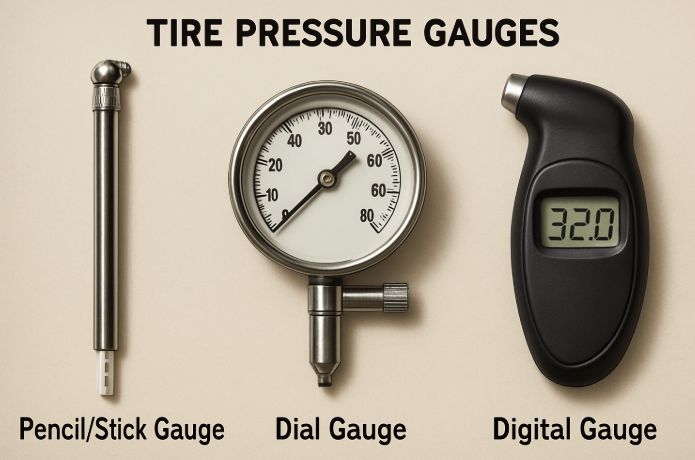
Tire Pressure Gauge: Available in three main types:
•Pencil/Stick Gauge: Affordable and compact, but less precise
•Dial Gauge: More accurate with an easy-to-read dial
•Digital Gauge: Most accurate with precise digital readings
2.Air Compressor: Access to an air compressor is necessary if you need to add air. These are available at:
•Most gas stations (sometimes requiring a small fee)
•Home units that plug into your car’s 12V outlet
•Larger units for home garages
3.Valve Caps: Keep track of your valve caps during the process, as they protect your valve stems from dirt and moisture.
Preparing to Check Your Tire Pressure
For the most accurate readings, follow these preparation steps:
1.Check When Tires Are Cold: “Cold” means the vehicle has been parked for at least three hours or hasn’t been driven more than a mile. Driving heats the air inside your tires, temporarily increasing pressure and giving inaccurate readings.
2.Park on Level Ground: Ensure your vehicle is parked on a flat, level surface to get consistent readings across all tires.
3.Have Your Target PSI Ready: Know the recommended tire pressure for your vehicle before you begin. Remember, this information is found on the driver’s side door jamb, in your owner’s manual, or inside the fuel filler door—not on the tire itself.
Step-by-Step Process for Checking Tire Pressure
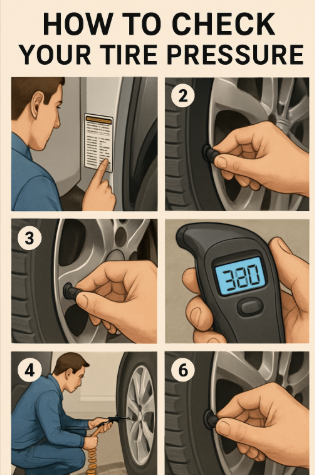
Step 1: Remove the Valve Cap
Unscrew the valve cap from the tire’s valve stem. Place it somewhere secure where it won’t get lost—a pocket or cupholder works well. The valve stem is the small, pencil-sized protrusion from the wheel where you add air.
Step 2: Press the Tire Gauge onto the Valve Stem
Place the open end of your tire pressure gauge firmly onto the valve stem. Press straight and firmly enough that you don’t hear air hissing out around the sides. For most gauges, you’ll hear a brief hiss as the gauge connects and measures the pressure.
Step 3: Read the Pressure Measurement
Different types of gauges display the reading differently:
- Stick Gauge: A small bar extends from the end of the gauge, with measurement markings along its length
- Dial Gauge: The needle points to the pressure reading on the circular dial
- Digital Gauge: The pressure appears as a number on the digital display
Note the reading and compare it to your vehicle’s recommended PSI.
Step 4: Adjust the Pressure if Necessary
If your tire pressure is lower than recommended:
1.Position the air compressor hose on the valve stem, similar to how you positioned the gauge
2.Turn on the compressor and add air in short bursts
3.Recheck the pressure with your gauge after each burst
4.Continue until you reach the recommended PSI
If your tire pressure is higher than recommended:
1.Use the small nub on the back of the gauge (or a small tool) to press the pin in the center of the valve stem
2.Release air in short bursts
3.Recheck the pressure with your gauge after each burst
4.Continue until you reach the recommended PSI
Step 5: Replace the Valve Cap
Once the pressure is correct, firmly screw the valve cap back onto the valve stem. This prevents dirt and moisture from entering the valve and causing damage or slow leaks.
Step 6: Repeat for All Tires
Follow the same procedure for each tire, including the spare tire if your vehicle has one. Some vehicles have different recommended pressures for front and rear tires, so be sure to check the specifications for each.
Common Mistakes to Avoid
- Checking Hot Tires: Tires heat up during driving, which increases pressure. For accurate readings, check when tires are cold.
- Using Gas Station Gauges Exclusively: Built-in gauges on air compressors at gas stations are often inaccurate due to heavy use and abuse. Always use your personal gauge for accurate readings.
- Forgetting the Spare: Your spare tire needs proper inflation too. Check it regularly so it’s ready when you need it.
- Setting to Maximum Pressure: Never inflate to the maximum pressure listed on the tire sidewall. Always use the manufacturer’s recommended pressure for your specific vehicle.
- Eyeballing It: Never estimate tire pressure by looking at the tire. Even a tire that’s 10 PSI low can look normal to the naked eye.
Tips for Accurate Readings
- Invest in a quality digital tire pressure gauge for the most accurate readings
- Check all tires at the same time under similar temperature conditions
- If you must check warm tires, add 4-5 PSI to the recommended cold pressure as a temporary adjustment
- Consider marking your valve caps with a dot of colored nail polish to help track which tires you’ve checked
- Keep a log of your tire pressure readings to identify any tires that may be losing air more quickly than others, indicating a possible slow leak
By following this step-by-step guide, you’ll ensure your tires are properly inflated for optimal safety, performance, and longevity. Remember that proper tire inflation is one of the simplest yet most effective maintenance tasks you can perform on your vehicle.
Impact of Temperature on Tire Pressure
The Science Behind Temperature and Pressure
The relationship between temperature and tire pressure is governed by fundamental laws of physics. Air, like all gases, expands when heated and contracts when cooled. This principle, known as Gay-Lussac’s Law, has significant implications for your vehicle’s tires throughout the year.
When the temperature of the air inside your tires increases, the air molecules move more rapidly and exert greater pressure on the tire walls. Conversely, when temperatures drop, air molecules slow down and exert less pressure, resulting in lower tire pressure.
The rule of thumb established by tire experts is that tire pressure changes by approximately 1 PSI for every 10°F (5.6°C) change in ambient temperature. This means that significant temperature swings—whether seasonal changes or even the difference between a cold morning and a hot afternoon—can have a measurable impact on your tire pressure.
Seasonal Changes and Their Effects
Winter Challenges
Winter presents the most significant challenges for maintaining proper tire pressure. In most parts of North America, the difference between average summer and winter temperatures is about 50°F, which can result in a potential loss of about 5 PSI as winter temperatures set in. This 5 PSI loss is enough to significantly compromise handling, traction, and tire durability.
Cold weather tire pressure drops are particularly dangerous because:
- They occur gradually as temperatures fall, often going unnoticed
- They coincide with road conditions that already demand optimal tire performance (snow, ice, rain)
- They happen during a season when many drivers are less inclined to perform maintenance outdoors
If you park your vehicle in a heated garage during winter, be aware that your tire pressure will drop when you drive into the colder outside environment. Tire experts recommend adding 1 PSI to compensate for each 10°F difference between your heated garage and the outside temperature.
Summer Considerations
Summer brings its own set of challenges. High temperatures can cause tire pressure to increase, potentially leading to overinflation if tires were filled to the recommended pressure during cooler weather.
Additionally, the sun’s radiant heat can artificially and temporarily increase tire pressures beyond what the ambient temperature alone would cause. In a controlled test conducted by Tire Rack, a tire placed in direct sunlight increased from 35 PSI to 40 PSI over the course of a day, while an identical tire kept in the shade only increased to 36.5 PSI.
Daily Temperature Fluctuations
Even within a single day, temperature changes can affect your tire pressure. The difference between cold nighttime temperatures and hot daytime temperatures in most regions is about 20°F. This means that after setting tire pressures first thing in the morning, your vehicle’s tire pressures will be almost 2 PSI higher when measured in the afternoon (assuming the vehicle is parked in the shade).
This daily fluctuation creates a potential problem: if you set your tire pressures during the heat of the day, they will likely be approximately 2 PSI low the following morning when the tires are cold. Since the manufacturer’s recommended pressure is specifically for cold tires, this means your tires would be underinflated for your morning commute.
Driving and Tire Temperature
Beyond ambient temperature effects, the act of driving itself generates heat in your tires. As tires flex and roll against the road surface, friction generates heat that increases the air pressure inside.
In testing conducted by tire manufacturers, tire pressure typically increases by about 1 PSI during every 5 minutes of driving for the first 20 minutes, then stabilizes with minimal additional increases. This means that even a short drive to inflate your tires will result in a temporary pressure increase that will dissipate once the tires cool down.
This driving-induced pressure increase explains why tire manufacturers and vehicle makers specify that pressure should be checked when tires are “cold”—meaning before you’ve driven more than a mile or two, or after the vehicle has been parked for at least three hours.
Best Practices for Temperature Variations
To account for temperature effects on tire pressure, follow these best practices:
- Check Pressure in the Morning: Always check and adjust tire pressure in the morning before driving, when tires are at their coldest and closest to the ambient temperature.
- Adjust Seasonally: Be especially vigilant about checking tire pressure when seasons change, particularly in fall as temperatures begin to drop.
- Don’t Release Air in Summer: If your properly inflated tires gain pressure during hot weather, don’t release air unless the pressure exceeds the manufacturer’s maximum. The pressure will drop again when temperatures cool.
- Consider Temperature When Traveling: If you’re traveling between regions with significantly different climates, check your tire pressure upon arrival and adjust as necessary.
- Use a Quality Gauge: Invest in a good-quality tire pressure gauge and keep it in your vehicle. Gas station gauges are often inaccurate due to heavy use and exposure to the elements.
By understanding how temperature affects tire pressure and taking proactive steps to monitor and adjust accordingly, you can maintain optimal tire performance and safety year-round, regardless of weather conditions.
Dangers of Underinflation and Overinflation
The Risks of Underinflated Tires
Underinflation is perhaps the most common tire pressure issue, and unfortunately, it’s also one of the most dangerous. When tires don’t have enough air pressure, a cascade of problems can occur that affect safety, performance, and your wallet.
Safety Hazards of Underinflation
Reduced Vehicle Control: Underinflated tires result in decreased handling and responsiveness. Your ability to steer, brake, and navigate corners may be compromised, increasing the risk of accidents, especially in emergency situations. The tire’s contact patch with the road becomes distorted, reducing the tire’s ability to grip the road properly.
Increased Braking Distance: With underinflated tires, stopping distances increase significantly. Tests have shown that a vehicle with tires underinflated by just 30% can take up to 11 feet longer to stop from 60 mph—a distance that could mean the difference between a near miss and a serious collision.
Risk of Blowouts: Perhaps the most dangerous consequence of underinflation is the increased risk of tire blowouts. When a tire is underinflated, excessive flexing occurs in the sidewalls. This flexing generates heat, which weakens the tire structure over time. According to safety studies, vehicles with tires that were underinflated by at least 25% were three times more likely to be involved in a tire-related crash.
Hydroplaning Vulnerability: Underinflated tires are more susceptible to hydroplaning on wet roads. The distorted contact patch cannot effectively channel water away from beneath the tire, increasing the likelihood of losing traction on wet surfaces.
Performance and Economic Impact
Accelerated Tire Wear: Underinflated tires wear unevenly, with excessive wear occurring on the outer edges of the tread. Some tire manufacturers advise that just 5 PSI below placard pressure could lessen a tire’s tread life by as much as 25%.
Reduced Fuel Economy: As mentioned earlier, the U.S. Department of Energy estimates that underinflated tires can lower gas mileage by approximately 0.2% for every 1 PSI drop in pressure of all four tires. This means that driving with tires that are 10 PSI underinflated could reduce your fuel economy by up to 2%.
Suspension and Chassis Damage: Underinflated tires put greater pressure on the corners of your vehicle’s suspension and chassis, potentially causing damage to vital components that can be expensive to repair.
The Dangers of Overinflated Tires
While underinflation gets more attention, overinflation also presents significant risks that shouldn’t be overlooked.
Safety Concerns with Overinflation
Reduced Traction: Overinflated tires have a smaller contact patch with the road, reducing traction and grip. This can lead to longer stopping distances and reduced control, particularly on wet or slippery surfaces.
Increased Vulnerability to Road Hazards: When tires are overinflated, they become more rigid and less able to absorb impacts. This makes them more susceptible to damage from potholes, road debris, and other hazards. A properly inflated tire can flex slightly to absorb these impacts, while an overinflated tire is more likely to suffer cuts, punctures, or sidewall damage.
Harsher Ride Quality: Overinflated tires transmit more road shock to the vehicle, resulting in a harsher, more uncomfortable ride. This not only affects comfort but can also lead to increased driver fatigue on longer journeys.
Unpredictable Handling: Vehicles with overinflated tires may exhibit unpredictable handling characteristics, particularly during cornering or emergency maneuvers. The reduced contact patch can cause the vehicle to respond differently than expected, potentially leading to loss of control.
Performance and Economic Impact
Uneven Tire Wear: Overinflated tires wear more in the center of the tread than on the edges. This uneven wear pattern reduces the tire’s lifespan and necessitates earlier replacement.
Reduced Traction in Adverse Conditions: The smaller contact patch of overinflated tires provides less grip in snow, ice, or rain, making driving in adverse conditions more dangerous.
Finding the Balance: Proper Inflation
The key to avoiding the dangers of both underinflation and overinflation is to maintain your tires at the manufacturer’s recommended pressure. This “Goldilocks zone” of tire pressure provides the optimal balance of:
- Safety through proper vehicle handling and braking
- Comfort with appropriate ride quality
- Economy through maximum tire life and optimal fuel efficiency
- Performance with responsive handling and appropriate road feel
Remember that the recommended pressure is specifically for cold tires, and it’s designed to account for the normal pressure increase that occurs as tires warm up during driving. By maintaining this recommended pressure, you ensure that your tires operate within their designed parameters throughout their temperature range.
Warning Signs of Improper Inflation
Being aware of the warning signs of improper inflation can help you address issues before they lead to dangerous situations:
Signs of Underinflation:
- Vehicle pulling to one side
- Excessive vibration or wobbling
- Decreased fuel economy
- Visibly sagging tire sidewalls
- Excessive heat when touching the tires after driving
Signs of Overinflation:
- Unusually harsh ride
- Excessive wear in the center of the tread
- Reduced traction, especially in wet conditions
- Increased susceptibility to impact damage
While modern vehicles are equipped with Tire Pressure Monitoring Systems (TPMS) that alert drivers to significant underinflation, these systems typically only warn when pressure drops 25% or more below the recommended level—by which point, damage may already be occurring. Regular manual checks remain essential for optimal tire performance and safety.
Real-Life Scenario: Sarah’s Tire Pressure Wake-Up Call
Sarah Marshall from Boston, a 35-year-old marketing professional, was running late for an important client meeting one cold November morning. As she rushed to her car, she noticed that her vehicle seemed to be sitting slightly lower on the driver’s side, but in her hurry, she dismissed it and drove off.
During her 30-mile commute on the highway, Sarah noticed her car pulling slightly to the left and felt the steering wheel vibrating more than usual. The vehicle also seemed less responsive when turning, and she had to apply more pressure to the brake pedal than normal to slow down at exits.
When she finally arrived at her destination and parked, she noticed that her fuel gauge had dropped more than it typically would for her regular commute. As she walked around her car, she saw that her front left tire appeared visibly underinflated compared to the others.
After her meeting, Sarah stopped at a gas station to check her tire pressure. Using the air pressure gauge at the station, she discovered that her front left tire was at only 20 PSI, while the vehicle manufacturer’s recommended pressure (listed on the driver’s side door jamb) was 32 PSI. The other three tires were also below the recommended pressure, reading between 26-28 PSI.
Sarah remembered that the last time she had checked her tire pressure was during the summer, about four months ago. The recent drop in temperature (from average summer temperatures of 85°F to current fall temperatures of 45°F) had caused the air in her tires to contract, lowering the pressure. Additionally, her front left tire had a slow leak from a small nail embedded in the tread.
After properly inflating all four tires to the recommended 32 PSI, Sarah immediately noticed improvements on her drive home:
- The car no longer pulled to the left
- The steering felt more responsive
- Braking distance was reduced
- The ride was smoother with less vibration
The next day, Sarah had the punctured tire repaired at a local tire shop. The technician explained that driving on underinflated tires had caused uneven wear on her tires, particularly on the edges of the tread on her front left tire. He estimated that this premature wear had reduced the tire’s lifespan by approximately 25%.
Sarah now keeps a personal tire pressure gauge in her glove compartment and has set a monthly reminder on her phone to check her tire pressure, with additional checks before long trips and when seasons change. This simple maintenance routine has improved her vehicle’s safety, handling, fuel efficiency, and extended the life of her tires.
Taking Control of Your Tire Pressure
Maintaining proper tire pressure is one of the simplest yet most impactful maintenance tasks you can perform on your vehicle. As we’ve explored throughout this guide, correct tire inflation affects virtually every aspect of your driving experience—from safety and handling to fuel economy and tire longevity.
The small investment of time required to check your tire pressure monthly and before long trips pays significant dividends. Just a few minutes with a quality tire pressure gauge can:
- Enhance your safety on the road through improved handling and shorter braking distances
- Save you money at the pump by optimizing fuel efficiency
- Extend the life of your tires, delaying costly replacements
- Provide a more comfortable, controlled driving experience
- Reduce your vehicle’s environmental impact through decreased fuel consumption
Remember that tire pressure is not a “set it and forget it” aspect of vehicle maintenance. External factors like temperature changes, natural air loss over time, and the occasional puncture or leak mean that tire pressure requires ongoing attention. By incorporating regular pressure checks into your maintenance routine, you transform this simple task into a powerful tool for vehicle optimization.
The next time you’re at your vehicle, take a moment to locate your tire pressure placard, check your current PSI levels, and make any necessary adjustments. Your tires—and everything that depends on them—will thank you for it.
Safe travels and happy motoring!