
Have you ever looked at the side of your tire and wondered what all those numbers and letters actually mean? You’re not alone. The cryptic code that wraps around your tire’s sidewall contains vital information that directly impacts your vehicle’s safety, performance, and handling characteristics. Understanding these markings isn’t just for mechanics or car enthusiasts—it’s essential knowledge for every car owner.
Your tires are the only point of contact between your vehicle and the road, making them one of the most critical safety components of your car. The information encoded on the sidewall tells you everything from the tire’s size and load-carrying capacity to its speed rating and manufacturing date. This knowledge becomes particularly valuable when it’s time to replace your tires or when you’re considering upgrading to a different type for improved performance.

Many drivers simply trust their mechanic or tire shop to select the right replacement tires, but having a basic understanding of tire sidewall codes empowers you to make informed decisions. Using the wrong tire specifications can lead to poor handling, reduced fuel efficiency, inaccurate speedometer readings, and even dangerous driving conditions. In contrast, knowing how to read these codes allows you to verify that you’re getting exactly what your vehicle needs.
In this comprehensive guide, we’ll break down each component of the tire sidewall code in simple, easy-to-understand terms. We’ll explain what each number and letter represents, why it matters, and how you can use this information when shopping for new tires. Whether you’re a first-time car owner or someone who wants to become more knowledgeable about vehicle maintenance, this guide will transform those mysterious markings into valuable insights that help you make better decisions about your vehicle’s tires.

By the time you finish reading, you’ll be able to look at any tire and understand its size dimensions, load capacity, speed capabilities, and more. You’ll also learn practical tips for using this information when purchasing new tires, ensuring you get the right fit for your vehicle and driving needs. Let’s demystify those sidewall codes and put you in the driver’s seat when it comes to understanding your tires.
Breaking Down the Tire Type Code
The first character you’ll encounter on your tire’s sidewall is a letter that indicates the tire’s class or type. This seemingly small detail actually reveals a lot about the tire’s intended use and construction standards. Let’s examine what each of these tire type designations means and why they matter for your vehicle.

Passenger (P) Tires
The most common tire type you’ll encounter is designated by the letter “P,” which stands for “Passenger.” P-metric tires are designed specifically for passenger vehicles including:
- Standard passenger cars
- Minivans
- Crossovers
- SUVs
- Light-duty pickup trucks
- Electric vehicles (EVs)
P-metric tires follow standards established by the U.S. Tire and Rim Association and are built to handle the weight, performance needs, and comfort requirements of everyday passenger vehicles. These tires prioritize a balance of fuel efficiency, ride comfort, noise reduction, and adequate load-carrying capacity for typical passenger vehicle applications.
For electric vehicles, while standard P-metric tires can be used if they meet the proper load capacity, some manufacturers now offer specialized EV tires (sometimes marked with “EV” on the sidewall). These are designed to handle the additional weight of battery packs and deliver the quiet ride and lower rolling resistance that EV owners expect.
Light Truck (LT) Tires
When you see “LT” at the beginning of the tire code, you’re looking at a Light Truck tire. These tires are engineered for:
- Full-size pickup trucks
- Large SUVs
- Vans
- Vehicles used for towing or hauling heavy loads
LT tires feature more robust construction than P-metric tires, with reinforced sidewalls and often deeper tread patterns. They’re built to handle heavier loads, provide more durability in demanding conditions, and withstand the additional stress that comes with towing or carrying cargo. The trade-off is that LT tires typically provide a firmer ride than P-metric tires and may generate more road noise.
It’s worth noting that many three-quarter-ton and one-ton trucks require LT tires due to their weight and load-carrying requirements. Using P-metric tires on a vehicle that should have LT tires can lead to premature tire failure, poor handling, and unsafe driving conditions when carrying heavy loads or towing.
Special Trailer (ST) Tires
The “ST” designation identifies Special Trailer tires, which are specifically designed for use on trailers, not on drive or steering axles of vehicles. These include:
- Travel trailers
- Boat trailers
- Utility trailers
- Fifth-wheel trailers
ST tires have unique construction features that address the particular demands of trailer applications. They typically have stiffer sidewalls to reduce trailer sway, specialized compounds to resist heat buildup (since trailer tires don’t benefit from the cooling effect of engine airflow), and construction designed to handle heavy loads while being pulled rather than driven.
It’s crucial never to use ST tires on a passenger vehicle or truck, as they’re not designed for steering or driving functions. Similarly, using P-metric or LT tires on a trailer can lead to handling issues, excessive heat buildup, and potential tire failure.
European Metric (No Prefix) Tires
If there’s no letter before the first number in the tire size, you’re looking at a European Metric tire (sometimes called Euro-Metric or Hard Metric). These tires follow European Tyre and Rim Technical Organisation (ETRTO) standards rather than U.S. standards.
European Metric tires are common on:
- European vehicle imports
- Some Asian imports
- Certain luxury vehicles
While similar in appearance to P-metric tires, European Metric tires often have slightly different load capacities and performance characteristics. When replacing tires, it’s important to understand that a European Metric tire and a P-metric tire of the same size designation may have different load capacities, so always check the load index to ensure compatibility.
Other Special Designations
Beyond the main tire types, you might encounter other prefixes or suffixes that provide additional information:
C (Commercial): Often seen on van tires in European markets, indicating tires designed for commercial vans and light trucks.
T (Temporary): Designates a temporary spare tire, which has limited use capabilities and speed restrictions.
XL (Extra Load): Indicates a tire with a higher load capacity than standard tires of the same size.
HL (High Load): Similar to XL, denotes tires with reinforced construction for higher load capacity.
RF or ZR (Reinforced): Indicates strengthened construction, often found on performance tires.
Why Tire Type Matters
Choosing the correct tire type for your vehicle isn’t just about following manufacturer recommendations—it directly impacts:
1.Safety: Using the wrong tire type can compromise handling, braking, and stability, especially in emergency situations.
2.Load Capacity: Different tire types have different load-bearing capabilities, which affects how much weight your vehicle can safely carry.
3.Ride Quality: P-metric tires generally provide a smoother, quieter ride than LT tires, which are firmer and potentially noisier.
4.Fuel Economy: Tire type can affect rolling resistance, which impacts fuel consumption.
5.Tire Lifespan: Using a tire type not suited to your vehicle or driving needs can lead to premature wear and reduced tire life.
When replacing tires, always start by identifying the tire type recommended by your vehicle manufacturer. This information can be found in your owner’s manual or on the vehicle’s tire placard (usually located on the driver’s door jamb, glove box, or fuel door). While there may be valid reasons to switch between tire types in some circumstances (such as upgrading to LT tires for a passenger vehicle that will be used for frequent towing), these decisions should be made with a full understanding of the performance implications and in consultation with a tire professional.
Understanding Tire Width
After the tire type designation, the next component in the tire code is a three-digit number that represents the tire’s width. This measurement is crucial for understanding how your tire will perform and interact with your vehicle. Let’s explore what tire width means and why it matters.
What Is Tire Width?
Tire width refers to the measurement of the tire from one sidewall to the other—essentially how wide the tire is when viewed head-on. This measurement is always expressed in millimeters, regardless of whether the tire uses metric or imperial measurements for other dimensions.
For example, in a tire marked P215/65R16:
The “215” indicates that the tire is 215 millimeters wide from sidewall to sidewall.
This width measurement represents the widest point of the tire when properly mounted on the recommended rim width and inflated to the correct pressure. It’s important to note that the actual measured width might vary slightly depending on the rim width the tire is mounted on.
Common Tire Widths and Their Applications
Tire widths typically range from approximately 155mm for compact cars to over 335mm for high-performance sports cars. Here’s a general guide to common tire widths and their typical applications:
- 55mm-185mm: Compact cars, economy vehicles, and some older vehicles
- 195mm-225mm: Mid-size sedans, small crossovers, minivans, and small SUVs
- 235mm-275mm: Full-size sedans, SUVs, light trucks, and some performance vehicles
285mm-335mm+: High-performance vehicles, sports cars, and some specialized trucks
It’s worth noting that within each vehicle category, there can be significant variation based on the specific model, trim level, and intended use. For instance, a sport-oriented version of a sedan might come with wider tires than the base model of the same car.
How Tire Width Affects Performance
The width of your tires has a significant impact on several aspects of your vehicle’s performance:
1. Traction and Grip
Generally speaking, wider tires provide more traction because they have a larger contact patch (the area of the tire that touches the road). This increased road contact can improve:
- Cornering ability
- Braking performance
- Acceleration (especially in high-powered vehicles)
- Grip in dry conditions
However, it’s not always as simple as “wider is better.” Extremely wide tires can actually reduce traction in wet or snowy conditions because they’re more likely to hydroplane on water or float on top of snow rather than cutting through it.
2. Handling and Stability
Wider tires generally improve a vehicle’s handling characteristics by:
- Reducing sidewall flex during cornering
- Improving steering response
- Enhancing overall stability during quick maneuvers
These benefits make wider tires popular for sports cars and performance-oriented vehicles where precise handling is prioritized.
3. Ride Comfort
Tire width affects ride quality in several ways:
- Wider tires tend to transmit more road noise into the cabin
- They may provide a firmer ride as they have less ability to absorb small road imperfections
- They can be more susceptible to road hazards like potholes due to the larger surface area exposed to impact
4. Fuel Economy
Tire width has a direct impact on fuel efficiency:
- Wider tires create more rolling resistance, which requires more energy to overcome
- This increased resistance translates to higher fuel consumption
- For electric vehicles, wider tires can reduce range
This is why many economy-focused vehicles and hybrids come equipped with relatively narrow tires designed to minimize rolling resistance and maximize efficiency.
Considerations When Changing Tire Width
If you’re considering changing the width of your tires, there are several important factors to keep in mind:
1. Vehicle Specifications
Always consult your vehicle’s owner’s manual or the tire placard (usually found on the driver’s door jamb) for the recommended tire sizes. Manufacturers specify tire sizes based on extensive testing to ensure optimal performance, safety, and efficiency.
2. Wheel Width Compatibility
Tires must be mounted on wheels of appropriate width. Each tire size has a range of compatible rim widths, and using a wheel that’s too narrow or too wide for the tire can cause:
- Improper tire seating
- Unpredictable handling
- Premature tire wear
- Potential tire failure
As a general rule, the wheel width in inches should be approximately 70-85% of the tire width in millimeters. For example, a 215mm wide tire typically works best on wheels that are between 6.5 and 8 inches wide.
3. Clearance Issues
Wider tires may cause clearance problems with:
- Wheel wells
- Suspension components
- Steering mechanisms
- Body panels during full suspension compression or extreme steering angles
Before upgrading to wider tires, ensure there’s adequate clearance in all driving conditions.
4. Speedometer Accuracy
Changing tire width can affect the overall diameter of the tire, which in turn affects speedometer readings. If you significantly alter your tire width, you may need to recalibrate your speedometer to maintain accuracy.
5. Plus Sizing
“Plus sizing” is a common approach when upgrading to wider tires. This involves increasing the wheel diameter while decreasing the sidewall height to maintain approximately the same overall tire diameter. For example, moving from 215/65R16 to 225/55R17 provides a wider tire with similar overall dimensions.
Practical Examples
To illustrate how tire width works in practice, let’s look at some common examples:
- A Toyota Camry might come standard with 215mm wide tires, providing a good balance of comfort, efficiency, and handling for a mid-size sedan.
- A Ford F-150 pickup truck might use 275mm wide tires to support heavier loads and provide stability when towing.
- A Porsche 911 sports car might be equipped with 305mm wide rear tires to help put down the power of its high-performance engine and enhance cornering capabilities.
Finding the Right Width for Your Needs
When selecting tire width, consider your priorities:
- If fuel economy and a quiet ride are most important, stay with the manufacturer’s recommended width or even consider slightly narrower options if they’re within the approved range.
- If you prioritize handling and performance, wider tires (within the compatible range for your vehicle) might be beneficial.
- For all-weather versatility, extremely wide tires might not be ideal as they can perform poorly in rain and snow.
Remember that tire width is just one aspect of tire performance. The ideal tire for your vehicle will balance width with other factors like aspect ratio, construction type, tread pattern, and rubber compound to deliver the best overall performance for your specific needs.
Decoding Aspect Ratio
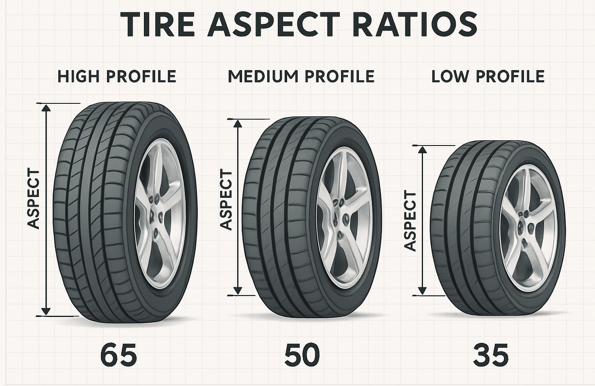
After the tire width, the next number you’ll encounter in the tire code is the aspect ratio. This two-digit number follows the forward slash (/) and provides crucial information about the tire’s profile. Understanding aspect ratio is essential for grasping how your tires will perform and appear on your vehicle.
What Is Aspect Ratio?
The aspect ratio represents the height of the tire’s sidewall expressed as a percentage of the tire’s width. In simpler terms, it tells you how tall the sidewall is in relation to how wide the tire is.
For example, in a tire marked P215/65R16:
- The “65” indicates that the sidewall height is 65% of the tire’s width
- Since the width is 215mm, the sidewall height would be approximately 139.75mm (215 × 0.65)
This measurement is taken from the rim to the top of the tread, essentially measuring the “profile” or “series” of the tire. The aspect ratio has a significant impact on both the performance characteristics and appearance of your tires.
High Profile vs. Low Profile Tires
Tires are often categorized based on their aspect ratios:
High Profile Tires (65 and above)
- Typically have aspect ratios of 65, 70, 75, or higher
- Provide more sidewall cushioning for a smoother ride
- Better at absorbing road imperfections and potholes
- Generally offer better traction in snow and off-road conditions
- More common on trucks, SUVs, and comfort-oriented vehicles
Mid Profile Tires (50 to 60)
- Strike a balance between comfort and handling
- Offer reasonable ride quality with improved cornering stability
- Common on many modern sedans, crossovers, and family vehicles
- Represent a compromise between high and low profile characteristics
Low Profile Tires (45 and below)
- Feature shorter sidewalls with aspect ratios like 45, 40, 35, or even lower
- Provide enhanced steering response and cornering stability
- Reduce sidewall flex during aggressive driving maneuvers
- Create a sportier appearance
- Common on sports cars, performance vehicles, and as upgrades for style-conscious owners
How Aspect Ratio Affects Performance
The aspect ratio of your tires influences several key performance characteristics:
1. Ride Comfort
Tires with higher aspect ratios (taller sidewalls) generally provide a more comfortable ride because:
- More rubber and air between the road and the rim acts as a cushion
- Greater ability to absorb impacts from potholes and road imperfections
- Less direct transmission of road vibrations to the vehicle
Conversely, low-profile tires with shorter sidewalls tend to create a firmer, sometimes harsher ride as they have less cushioning material to absorb impacts.
2. Handling and Responsiveness
Lower aspect ratios typically improve handling characteristics:
- Less sidewall flex during cornering means more precise steering response
- More direct road feel and feedback to the driver
- Better stability during quick direction changes
- Improved cornering grip due to less tread deformation
These handling benefits make low-profile tires popular for sports cars and performance-oriented vehicles.
3. Susceptibility to Damage
The aspect ratio affects how vulnerable tires are to certain types of damage:
- Lower profile tires are more susceptible to rim damage from potholes and curbs
- Higher profile tires provide better protection for expensive wheels
- Low-profile tires may be more prone to sidewall bulges from impact damage
This is an important consideration for drivers who frequently travel on rough or poorly maintained roads.
4. Visual Appearance
Aspect ratio has a significant impact on the look of your vehicle:
- Lower profile tires create a sportier, more aggressive stance
- Higher profile tires have a more traditional appearance
- The visual balance between wheel and tire changes dramatically with different aspect ratios
Many drivers choose lower profile tires purely for aesthetic reasons, even when there’s no performance benefit for their particular driving style.
Practical Examples and Calculations
To better understand aspect ratio, let’s look at some practical examples:
Example 1: Standard Sedan Tire
For a tire sized 205/65R16:
- Width: 205mm
- Aspect Ratio: 65
- Sidewall Height: 205mm × 0.65 = 133.25mm (approximately 5.25 inches)
Example 2: Performance Tire
For a tire sized 245/40R19:
- Width: 245mm
- Aspect Ratio: 40
- Sidewall Height: 245mm × 0.40 = 98mm (approximately 3.86 inches)
Despite the performance tire being 40mm wider, its sidewall is actually 35.25mm shorter due to the much lower aspect ratio.
Considerations When Changing Aspect Ratio
If you’re considering changing your tires’ aspect ratio, keep these important factors in mind:
1. Overall Tire Diameter
Changing the aspect ratio affects the overall diameter of the tire, which impacts:
- Speedometer and odometer accuracy
- Ground clearance
- Gear ratios and engine RPM at a given speed
- ABS and traction control system calibration
To maintain a similar overall diameter when changing aspect ratios, you typically need to adjust the wheel size accordingly. This is the principle behind “plus sizing” or “minus sizing” when upgrading or downgrading wheels.
2. Vehicle Dynamics
Different aspect ratios can significantly alter how your vehicle handles:
- Lowering the aspect ratio typically makes steering more responsive but can make the vehicle more darty or nervous on the highway
- Increasing the aspect ratio generally softens the ride but may reduce cornering precision
These changes might be desirable or undesirable depending on your preferences and driving style.
3. Clearance Issues
Changing aspect ratios can create clearance problems:
- Tires that are too tall might rub against fenders or suspension components
- Tires that are too short might expose gaps in wheel wells that affect appearance
Always ensure adequate clearance throughout the full range of suspension travel and steering movement.
4. Load Capacity
Altering the aspect ratio can affect a tire’s load-carrying capacity. Generally, tires with higher aspect ratios of the same width can carry more weight due to their larger air volume. Always check the load index when changing tire dimensions.
The Trend Toward Lower Aspect Ratios
Over the decades, there has been a clear trend toward lower aspect ratios across almost all vehicle categories:
- In the 1970s, aspect ratios of 70-78 were common on most vehicles
- By the 1990s, 65-series tires became standard on many passenger cars
- Today, many vehicles come from the factory with 55, 50, or even 45-series tires
This trend reflects both styling preferences and the improved handling characteristics that lower profile tires provide. However, it has also coincided with complaints about ride quality and increased susceptibility to wheel damage.
Finding the Right Balance
When selecting tires with different aspect ratios, consider your priorities:
- If ride comfort and pothole resistance are important, favor higher aspect ratios
- If handling precision and sporty appearance are priorities, lower aspect ratios may be preferable
- For a balance of performance characteristics, mid-range aspect ratios (55-60) often provide a good compromise
Remember that aspect ratio is just one factor in tire performance. The ideal tire will balance aspect ratio with appropriate width, construction type, tread pattern, and rubber compound to deliver the best overall performance for your specific needs and driving conditions.