

Ever wondered how do run-flat tires work? Imagine this: you’re cruising down the highway, music playing, enjoying the ride. Suddenly, *thump-thump-thump* – the unmistakable sound of a flat tire. But instead of pulling over immediately in a panic, you continue driving calmly to a safe location. That’s the magic of run-flat tires.
What are Run-Flat Tires?
Run-flat tires are tires designed to keep your vehicle moving even after a puncture. They allow you to drive a limited distance at a reduced speed after losing air pressure. This means no more immediate, dangerous roadside tire changes.
How Exactly Do Run-Flat Tires Work? The Core Mechanics
Run-flat technology mainly comes in two flavors: self-supporting and support ring systems. Let’s break down each one:
Self-Supporting Run-Flat Tires: Reinforced Sidewalls
These are the most common type. Self-supporting run-flats have incredibly strong, reinforced sidewalls. Think of them as having extra muscle. When a regular tire loses air, it collapses under the vehicle’s weight. But the reinforced sidewalls on these run-flats are tough enough to support the vehicle, even with zero air pressure. The rubber compound is very heat-resistant, too, because driving on a deflated tire generates a *lot* of friction and heat.
Real-life example: Imagine you’re driving home from a late-night event and get a puncture. Instead of being stranded on a dark road, you can drive to a well-lit service station or even all the way home, thanks to these reinforced sidewalls.
Support Ring Run-Flat Tires: The Inner Backbone
Support ring systems use a different approach. They feature a hard rubber or other material ring attached to the wheel, inside the tire. When the tire loses air, this support ring acts like an inner backbone, preventing the tire from collapsing and allowing you to continue driving. The ring supports the vehicle and maintains handling at lower speeds, while the reinforced sidewalls are also heat-resistant.
Think of it like this: it’s like having a spare “skeleton” inside your tire, ready to take over when needed.
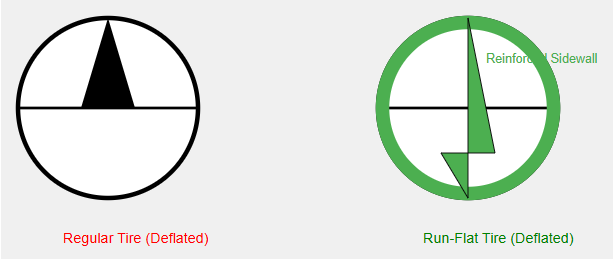
Run-Flat Tires vs. Conventional Tires: The Key Differences
The main difference is that a conventional tire will go completely flat when punctured, forcing an immediate stop. Run-flat tires offer that crucial “get you home” capability.
Benefits of Run-Flat Tires
- Safety: Avoid dangerous roadside tire changes.
- Convenience: Continue driving to a safe location or repair shop.
- Peace of Mind: Less worry about being stranded.
- Handling: Maintain some vehicle control even after a puncture.
Disadvantages of Run Flat Tires
- Ride Comfort: The reinforced sidewalls can sometimes make the ride a little firmer.
- Cost: They are usually more expensive than standard tires.
- Repair Limitations: Not all punctures in run-flat tires can be repaired.
- Tread Life: Some may have slightly shorter tread life.
Tire Pressure Monitoring System (TPMS) and Run-Flat Tires
Because run-flat tires can be difficult to visually assess for low pressure, a Tire Pressure Monitoring System (TPMS) is *essential*. TPMS alerts you to pressure loss, so you know when a tire has been punctured and you need to adjust your driving (lower speed, limited distance).
See also Alternatives to Run Flat Tires
Frequently Asked Questions (FAQs) about Run-Flat Tires
How far can I drive on a run-flat tire after a puncture?
Most run-flat tires allow you to drive up to 50 miles at a maximum speed of 50 mph after a puncture. However, always check your tire manufacturer’s specific recommendations.
Can run-flat tires be repaired?
It depends on the location and severity of the puncture. Some punctures, especially in the sidewall, may mean the tire needs replacing. A tire professional can advise you.
Are run-flat tires heavier than normal tires?
Yes, due to their reinforced construction.
Do I need special wheels for run-flat tires?
No, in the vast majority of cases, they will fit a standard wheel. Check for vehicle manufacturer approval.
How will I know that my run-flat tire is losing pressure?
Your Tire Pressure Monitoring System (TPMS) will illuminate on your dash.